How to Afford Your First Home in Washington: The FAFSA We Never Got
In this piece:
What buyers actually want to know
Measuring Up: the income limit that can disqualify you by $1
Key terms: DPA, grants, and first vs. second mortgages
A framework for sorting every type of assistance
What happens in other parts of the country
Every Washington down payment assistance program
Loans that lower or eliminate your down payment
What needs to change
I still remember the exact number. I was searching for a first-time homebuyer program in San Francisco, certain I'd qualify — and found out I was a thousand dollars over the income limit. Not over budget. Not unqualified to carry a mortgage. Just a thousand dollars over an arbitrary line called Area Median Income, or AMI.
That number has stuck with me for years. And every time I think about it, I end up wishing for the same thing: a consultant, a guide, a single place where all the information had already been gathered — so I wasn't wasting my time chasing programs I didn't qualify for.
Remember the FAFSA — the Free Application for Federal Student Aid? One application. You filled it out once, and it went and checked everything — federal aid, state grants, work-study, loans — and came back and told you what you actually qualified for. It didn't matter if the help was coming from the federal government, your state, or your school's own endowment. You didn't have to know that ahead of time. You just had to fill out one form, and the form did the sorting.
I wish, more than almost anything else in my work, that first-time homebuyers had something like that.
What buyers actually want to know
In my experience, most buyers don't care which institutional bucket their help comes from. They're not trying to become experts in public finance. What they want to know is simple:
What is available to me? What do I qualify for? And what combination gets me into a home?

That's what I'm going to try to do here — not a real FAFSA, but my own attempt at answering those three questions for Washington buyers, in one place.
The FAFSA metaphor is almost perfect, except for one frustrating difference: there is no single, universal application for homebuyer assistance. Instead, eligibility is scattered — state housing agencies, city programs, individual lenders, nonprofits, employers, and private programs. One buyer may qualify for a deferred loan through the Washington State Housing Finance Commission, or WSHFC. Another may be eligible for a Teacher Next Door grant, a lender credit, or city-funded assistance. A veteran may be sitting on a zero-down VA (Department of Veterans Affairs) loan and not know it. A buyer out in rural Pierce or Snohomish County may qualify for USDA (U.S. Department of Agriculture) financing and never think to ask.
Nobody hands you the list. You have to go find it, piece by piece, and hope you stumbled onto all of it.
Measuring Up
AMI is calculated per county, then adjusted for household size, and most assistance programs set their eligibility somewhere between 80% and 120% of it. It sounds precise. It is not always fair. A thousand dollars either way can be the difference between a program that exists for you and one that doesn't — and most people don't find that out until they're already partway through an application, hopeful.
And the income line wasn't even the only hoop. The San Francisco programs I was chasing worked much like the WSHFC programs I teach classes for today — and to qualify, I had to sit through a two-week course, in person, on a schedule that wasn't mine to choose. It was woefully boring. Instead, I wish I'd known ahead of time that I wouldn't qualify, before taking the class at all.
A few terms before we go further
This gets confusing fast if you don't already work in real estate, so a few quick definitions:
Down payment assistance (DPA) — the umbrella term for any money that helps cover your upfront cash to close: the down payment itself, closing costs, or both. DPA isn't one thing — it shows up as a grant, a forgivable loan, or a deferred loan, and which one matters a lot.
Closing costs — the fees on top of the down payment itself: appraisal, title insurance, lender fees, escrow, and more. People budget for the down payment and forget these exist, then get surprised at the closing table. Some DPA programs cover only the down payment; others cover both.
Grant — money you never pay back. No strings beyond the initial eligibility requirements. This is the rarest and most valuable kind of help on this list.

Deferred vs. Forgivable loans — the two words that get confused constantly, and shouldn't. Deferred means the loan is real and still has to be repaid — just not right now, usually not until you sell, refinance, or pay off the home. Forgivable means the debt disappears entirely if you meet certain conditions, usually staying in the home for a set number of years. A "0% interest" loan can still be deferred, not forgivable — 0% interest just means it won't grow while you wait to repay it.
Conventional loan — a mortgage not backed by a specific government program (unlike FHA, VA, or USDA loans below). It's the default most buyers picture when they think "getting a mortgage," typically requiring a stronger credit profile in exchange for more flexibility on the property itself.
PMI (private mortgage insurance) — an extra monthly cost added to a conventional loan when your down payment is below 20%, protecting the lender, not you, if you default. It usually goes away once you've built enough equity. Some loan types (VA, and NACA below) skip it entirely regardless of down payment size.
First mortgage — your main home loan, the one you're actually using to buy the house. This is what most people mean when they just say "my mortgage."
Second mortgage — a separate, smaller loan that sits behind the first one, usually used to deliver down payment assistance. Many are deferred, meaning no monthly payments — but see "deferred vs. forgivable" above, because that's not the same as free.
Keep these in your back pocket. Almost everything below is some combination of these terms.
Sorting the options by what they actually give you
Since there's no FAFSA to do this sorting for us, here's my attempt at organizing what's out there — not by who's offering it, but by what it actually does for you:
Type of help Examples What buyers must understand Money that does not have to be repaid Teacher Next Door grant; lender grants and credits Availability, required providers, and possible rate tradeoffs Forgivable assistance Washington's Covenant Homeownership Program; certain local programs Occupancy period and forgiveness conditions Deferred second mortgage Home Advantage, House Key/Opportunity, Seattle or Tacoma assistance No payment now does not mean free money Low- or zero-down financing VA, USDA, FHA, NACA, and 3%-down conventional loans Mortgage insurance, geography, and eligibility Discounted or restricted homes HUD (Housing and Urban Development) Good Neighbor Next Door, ARCH (A Regional Coalition for Housing), Habitat, community land trusts Inventory, resale restrictions, and occupancy rules Education and qualification help WSHFC classes and nonprofit housing counseling Often required before assistance can be approved
This is the part I actually love talking to buyers about, because once you see it laid out this way, it stops feeling like a maze and starts feeling like a set of tools — some free money, some patient money, some cheaper money, some restricted inventory, some just plain knowledge you need before any of the rest of it opens up.
What happens in other parts of the country
The other story I keep coming back to is one a friend of mine told me — an agent in Colorado. She has a program she loves recommending to her first-time buyers: down payment assistance through the Colorado Housing and Finance Authority, or CHFA, worth up to $25,000 toward a down payment and closing costs. Depending on the buyer, it comes as a true grant with no repayment, or a deferred second mortgage. Either way, she's used it to get people in the door who otherwise couldn't have bought at all.
She referred me to the lender who runs it — based in Florida, not even Colorado — excited for me to be able to offer it too. He looked at my address and said, "Oh, you're in Washington? That doesn't work here." He rattled off a list of states where it did work. Washington wasn't one of them.
That was it. No explanation. Just — not here.
And it made me wonder: why not? What would actually have to happen — legally, structurally, financially — for a program like that to exist in Washington too? I don't have the answer yet. But I don't think "it just doesn't work here" should be an acceptable final word on a program that's putting people in Colorado into homes right now.
To be clear, this isn't a knock on Washington specifically. When I looked into it, the pattern held up everywhere: assistance amounts and structures vary wildly state to state, and grants — money you never repay — are much rarer than deferred second mortgages, which is money you eventually do repay, just later. Washington's own programs, like Home Advantage and House Key, fall on the deferred-loan side of that line. That's not a flaw unique to us. It's just where the map currently stops.
What Washington actually offers
Before the list, one distinction that took me a minute to untangle myself: Home Advantage and House Key Opportunity aren't down payment assistance at all — they're the first mortgage itself, the actual loan you use to buy the house. Choosing one instead of a plain conventional loan gets you two things. First, a below-market interest rate on your primary loan — worth real money over 30 years, not a footnote. Second, it's the ticket that unlocks the DPA programs below: with a few exceptions, you generally can't access Home Advantage DPA, Opportunity DPA, Needs-Based DPA, HomeChoice, or Veterans DPA unless you're also using Home Advantage or House Key as your first mortgage. Think of the first mortgage as the vehicle — one that's already cheaper to drive — and Every Washington down payment assistance program erything below as the money riding along with it.
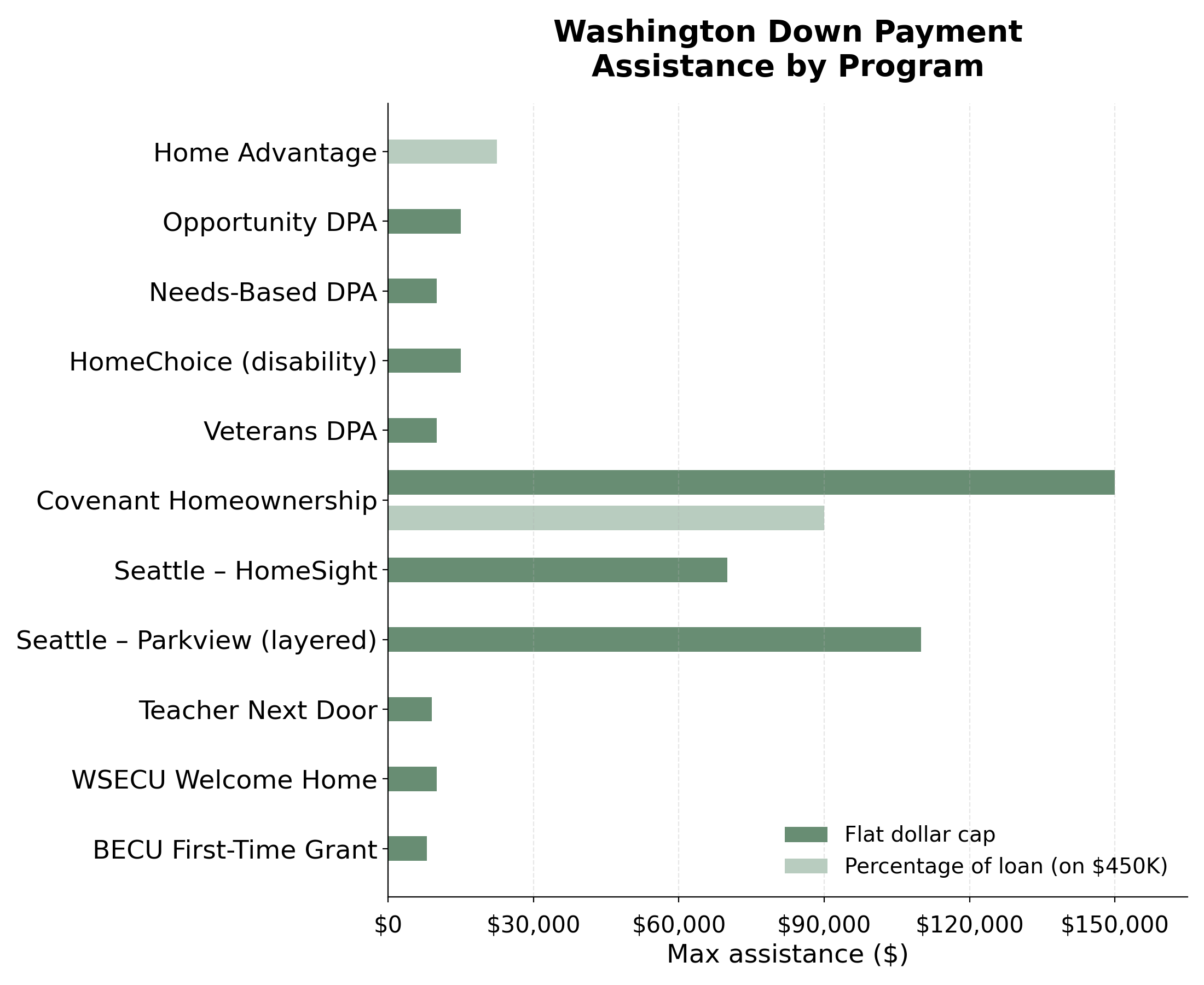
Home Advantage — The flagship first mortgage, paired with its own matching second mortgage: a deferred loan at 0% interest, worth 3% to 5% of your loan amount. No monthly payments on the second mortgage; the balance comes due when you sell, refinance, or pay off the home. It's the combination most Washington buyers reach for first.
Opportunity DPA — Paired with the House Key Opportunity first mortgage (the lower-income-limit counterpart to Home Advantage), this is a deferred second mortgage at 1% interest for a flat dollar amount.
Needs-Based DPA — A flat $10,000 deferred second mortgage at 3% interest, designed for buyers purchasing lower-priced homes (generally under roughly $250,000), where a percentage-based program wouldn't provide much help
HomeChoice DPA — A flat $15,000 deferred second mortgage at 1% interest, for buyers who have a disability or a household member with one.
Veterans DPA — A flat $10,000 deferred second mortgage, structured at a modest interest rate, for eligible veterans and their families.
Covenant Homeownership Program — A 0% interest deferred loan capped at the lesser of 20% of the purchase price or $150,000. Created to address Washington's history of racially restrictive housing covenants, it's available to eligible buyers whose families were excluded from homeownership by those covenants before 1968. Some lower-income borrowers can have the loan forgiven entirely after five years. Currently, demand is outpacing the monthly supply of funds, so buyers are placed in a queue rather than approved instantly — a strong program, but one that's presently stretched thin.
Seattle (via nonprofit partners) — Seattle no longer runs its own flat-dollar city program; instead, the Office of Housing partners with nonprofits. HomeSight offers low-interest loans up to $70,000. Parkview Services, layering multiple sources, can bring eligible buyers up to $110,000. Both are real money, just administered by community organizations rather than the city directly.
Tacoma — Tacoma has run a city program offering up to $80,000 as a 0% interest deferred loan, funded through the state's Housing Trust Fund. As of this writing, that funding has been fully committed and the program isn't accepting new applications. An older, smaller WSHFC-administered version (in the $20,000–$30,000 range) may still be active — worth checking directly before assuming either is available.
Teacher Next Door — Not a government or nonprofit program — a private company and referral network. It advertises a nonrepayable grant of up to $9,000, though the amount and availability depend on your location and transaction, and receiving it generally requires using the organization's own lender and real estate agent network. It also helps educators and other public servants find and apply for other down payment assistance programs (up to $24,000), though that money comes from those other programs, not from Teacher Next Door itself.
A few other private options:
WSECU Welcome Home Grant — up to $10,000 (5% of price), a true grant, no repayment. Requires WSECU membership and financing. WSECU itself has a nice origin story for a piece like this one: it was founded in 1957 after a state employee in Olympia couldn't find a single lender willing to help him with a $500 down payment.
BECU First-Time Homebuyer Grant — up to $8,000, a true grant, no repayment. Requires a BECU conventional loan.
Homes for Heroes — less a grant than a rebate network for teachers, healthcare workers, military, and first responders; participating agents typically return a portion of their commission, averaging around $3,000 in savings. Requires using the program's real estate and lending professionals.
A note on all of this: down payment assistance shifts with funding cycles, legislative sessions, and city budgets. Treat every number above as a starting point for a conversation with a lender or housing counselor, not a guarantee — some of these programs are flush right now, and at least one is currently out of money.
Or, skip the down payment question entirely
Everything above answers "how do I get money toward my down payment?" There's a separate, equally important question: "how much down payment do I actually need in the first place?" A few programs answer that one instead — they don't hand you cash, they shrink or eliminate the requirement itself.
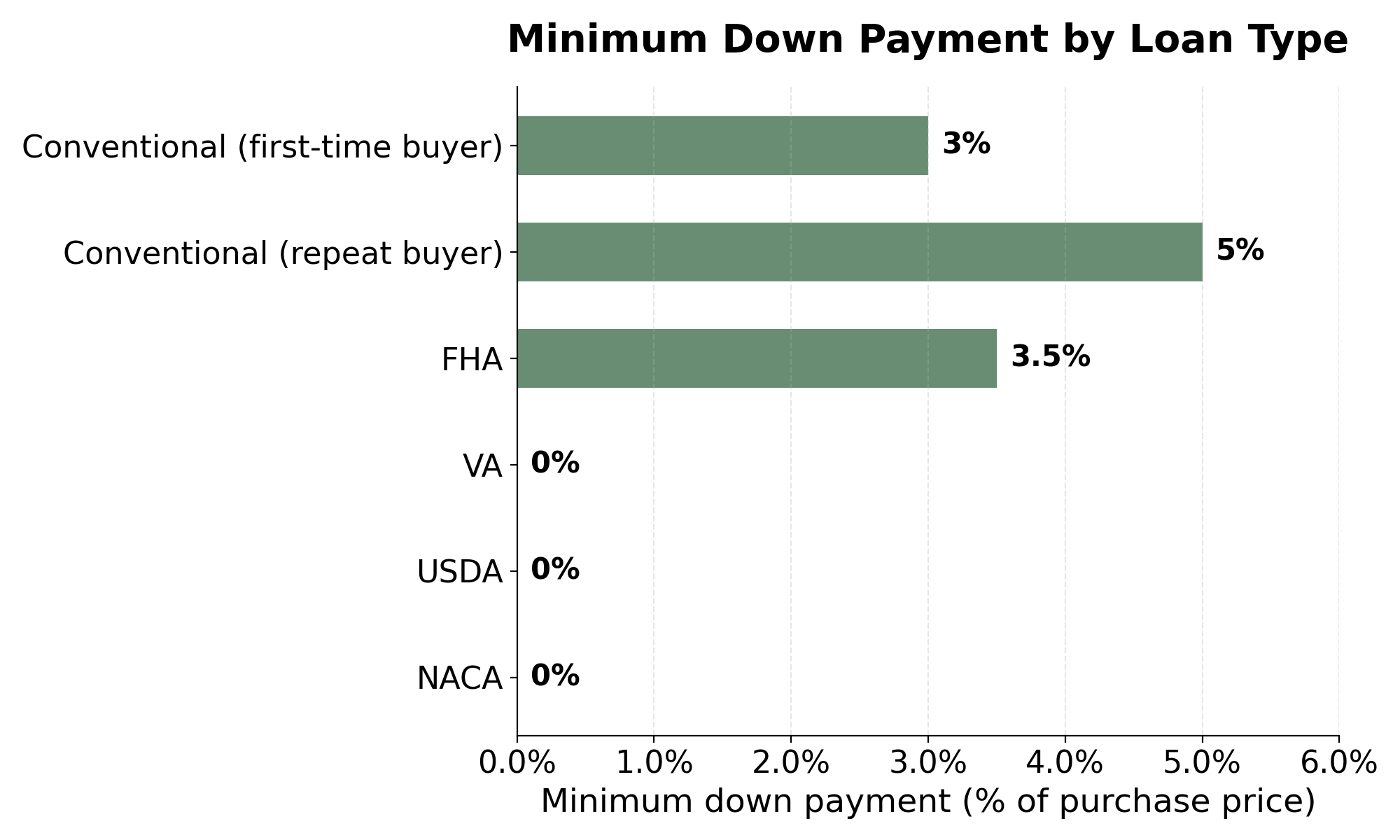
FHA (Federal Housing Administration) loans — down payments as low as 3.5% (or 10% with a lower credit score), with more flexible debt-to-income guidelines than a conventional loan.
VA loans — 0% down for eligible veterans, active-duty service members, reservists, National Guard members, and surviving spouses. No down payment, no PMI (private mortgage insurance).
USDA loans — 0% down for eligible buyers in qualifying rural areas, which in this region can include parts of Pierce and Snohomish County that a lot of buyers assume don't count as "rural."
NACA (Neighborhood Assistance Corporation of America) — a national nonprofit, not lender-specific: no down payment, no closing costs, no PMI, no lender fees, and no credit score consideration at all. Underwriting instead looks at your actual payment history and affordability. Focused on low- and moderate-income buyers, or buyers purchasing in low- and moderate-income neighborhoods — which makes it relevant to servers, gig workers, freelancers, and anyone else whose income doesn't fit neatly into conventional underwriting. The tradeoff: it's process-heavy. Expect counseling, careful documentation, and a system that runs more like a homeownership qualification course than a quick preapproval.
These four can also be paired with the down payment assistance programs above — a VA loan with zero down doesn't need a Home Advantage second mortgage, but an FHA loan's 3.5% might be exactly what Needs-Based DPA or a WSECU grant is designed to cover.
What needs to change
I want to be careful here, because this isn't a piece about politics — it's a piece about access. But I'll say this plainly: we don't need another intake form. We need more of what that Colorado program actually was — real money, funded and available, for first-time buyers.
Programs like that $25,000 grant, or forgivable down payment assistance more broadly, exist because someone decided first-time buyers were worth investing in. Buying your first home is a leap. You're committing to a number that terrifies you, based on a future income you're hoping holds steady, with no guarantee any of it works out the way you're picturing. That takes a kind of bravery that doesn't get talked about enough. It deserves to be funded, not just administered.
So my ask is simple: fund more of it. Wherever the money already works — Colorado, or anywhere else — figure out what it would take to bring it here, and do that. First-time buyers aren't asking for a shortcut. They're asking to be met halfway for taking the plunge at all.
And if I ever get my wish — one form, one place, that checks every program a buyer qualifies for — I already know what I'd call it. FAFSHA: Free Application For Starter-Home Aid. Not a real acronym. Not a real form. Yet.
Until it exists, I'm happy to be the next best thing. If you want someone who already knows which of these programs you might qualify for, and can help you actually put the pieces together — contact me or call/text 206-844-5518. That's what I'm here for.